


Q

Quantum Infoway

Node.js Development Company

Node.js Development Company for Backends That Scale

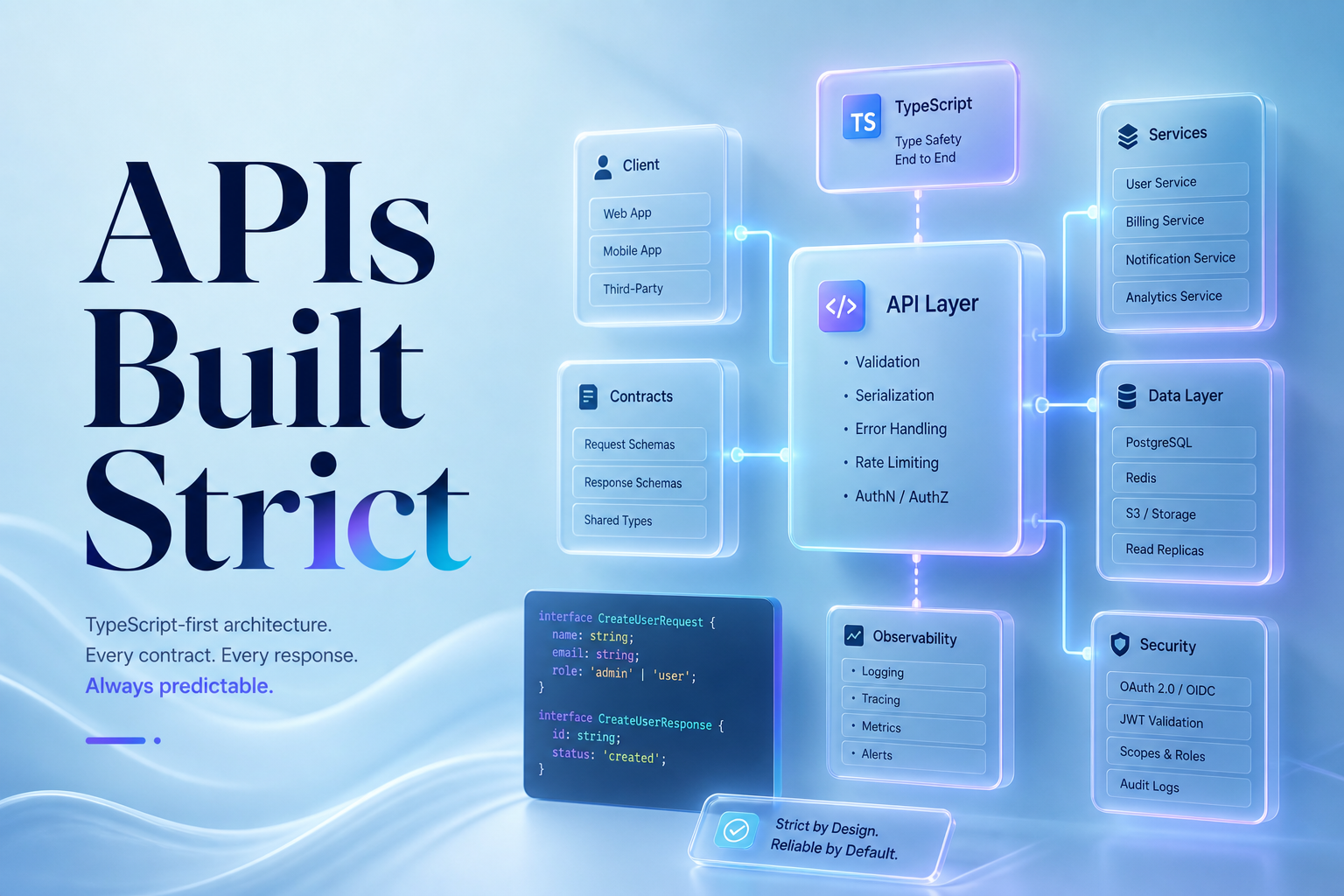
APIs, real time systems, microservices, and AI product backends in NestJS, Express, and strict TypeScript. Published pricing and delivery measured in weeks.

AI-native delivery Senior oversight Production focus
150+Happy Clients
12+Years Delivery
13+Countries Served
24hResponse Window
How We Work

Delivery that holds up in production

APIs, real time systems, microservices, and AI product backends in NestJS, Express, and strict TypeScript. Published pricing and delivery measured in weeks.

What We Deliver

Node.js Development Company for Backends That Sc Quantum Infoway ships

01

REST & GraphQL API Development

Versioned, documented APIs shared by web and mobile clients. OpenAPI specs, rate limiting, and auth patterns that pass security review.

02

Real-Time Applications

Live tracking, chat, notifications, and dashboards over WebSockets with backpressure handling. Proven in production on our fleet platform.

03

Microservices & Event-Driven Systems

Queue based architectures on BullMQ and RabbitMQ where scale demands them, and well structured monoliths where they do not.

04

AI Product Backends

Streaming LLM responses, tool orchestration, retrieval pipelines, and agent workloads. The Node.js event loop fits AI traffic patterns naturally.

05

Integrations & Middleware

ERPs, CRMs, payment gateways, and marketplaces connected on one trusted data model, replacing spreadsheet bridges and manual rekeying.

06

Modernization & Takeover

Technical audits, stabilization, test coverage, and incremental modernization of Node.js systems other teams built.

Ready to explore what AI can do for your business?

Tell Quantum Infoway about your workflow — we will propose a scoped next step.

Talk to an Expert
Technology We Work With

Stack Quantum Infoway works in

Core

PythonTypeScriptAWSOpenAI
Our Work

Work we have shipped

Replaced manual fleet operations with a real time platform on Node.js, Postgres, and AWS

Replaced manual fleet operations with a real time platform on Node.js, Postgres, and AWS

  • Centralized tracking that replaced spreadsheet-driven fleet ops
  • Live status views for dispatchers and field teams
  • Reliable mobile and web surfaces for day-to-day operations
LiveFleet tracking
LessManual ops
Mobile+ web
Unified sales, finance, and inventory for a diversified manufacturer on one Node.js data model

Unified sales, finance, and inventory for a diversified manufacturer on one Node.js data model

  • Distributor ordering for complex industrial catalogs
  • Search and filtering tuned to technical specs and part numbers
  • Field-ready layouts for tablet use on-site
35%Faster orders
2xDiscovery speed
40%Fewer support queries
Scaled StayVista to 1,000+ properties across 80+ destinations on a Laravel and Node backend

Scaled StayVista to 1,000+ properties across 80+ destinations on a Laravel and Node backend

  • Guest discovery and booking flows built for high inventory volume
  • AI recommendations and pricing insights for occupancy and revenue
  • Ops tooling that helps teams move faster with clearer data
50%Booking capacity
30%Ops cost down
40%Faster booking
Guide

How Quantum Infoway thinks about this work

What is Node.js development?

Node.js development is the engineering of backend systems in JavaScript and TypeScript on the Node.js runtime. APIs, real time applications, microservices, integration layers, and increasingly the orchestration backends behind AI products. A Node.js development company designs, builds, and operates these systems for you, covering architecture, engineering, QA, deployment, and long term support.

What Does a Node.js Development Company Do

A Node.js development company delivers backend systems as a service. Scoping and architecture, API design, database modeling, integration with the systems you already run, testing, deployment into cloud accounts you own, and ongoing support. The engagement is outcome shaped. You bring a product or an operation, and the company ships the backend that runs it. That is different from hiring individual developers into your own team, which is staff augmentation. We offer both, and this page covers project delivery. If you want engineers embedded in your team instead, see hire Node.js developers.

What Is Node.js Best Suited For

Node.js fits workloads that are network heavy and concurrency heavy rather than CPU heavy.

How Much Does Node.js Development Cost

At our published estimate ranges, a focused Node.js backend or API project costs $15,000 to $50,000. A mid sized platform with multiple integrations and role based access costs $50,000 to $150,000 over 4 to 8 months. Enterprise systems run $150,000 to $300,000 and up. Our blended rate is $25 to $50 per hour, and US agencies typically quote 3 to 5 times more for identical scope. Cost is driven by integrations, data migration, and compliance depth more than by endpoint count. The software cost guide has the full breakdown and a calculator.

How to Choose a Node.js Development Company

Five checks that separate production teams from portfolio sites.

Ready to explore what AI can do for your business?

Tell Quantum Infoway about your workflow — we will propose a scoped next step.

Talk to an Expert

FAQ

Node.js Development Company for Backends That Sc FAQs

What does a Node.js development company do?
A Node.js development company designs, builds, and operates backend systems in JavaScript and TypeScript on the Node.js runtime. That covers REST and GraphQL APIs, real time applications, microservices, integration layers, and AI product backends. The full cycle includes architecture, engineering, QA, deployment into cloud accounts you own, and ongoing support. It differs from hiring individual developers, which is staff augmentation. We offer both models.
How much do Node.js development services cost?
At our published estimate ranges, a focused Node.js API or backend costs $15,000 to $50,000, a mid sized platform costs $50,000 to $150,000, and enterprise systems run $150,000 to $300,000 and up, at a blended rate of $25 to $50 per hour. US agencies typically quote 3 to 5 times more for identical scope. Integrations, data migration, and compliance depth drive cost more than endpoint count.
Which Node.js frameworks do you use?
NestJS is our default for structured platforms because its module system, dependency injection, and decorators keep large codebases maintainable. Express and Fastify fit lighter services and high throughput APIs. Everything is strict TypeScript with automated tests, linting, and CI from the first commit.
Is Node.js good for AI product backends?
Yes. AI backends spend most of their time waiting on model APIs, vector databases, and external tools, which is exactly the workload the Node.js event loop handles well. We build streaming LLM responses, tool orchestration, and queue based agent workloads in Node.js, and pair it with Python where model training or heavy data science is involved.
Can you take over or modernize an existing Node.js codebase?
Yes. A large share of our work is inheriting Node.js systems other teams built. We start with a technical audit covering dependencies, security, test coverage, and architecture, so you know the real state of the codebase before committing to a roadmap. Then we stabilize, add tests, and modernize incrementally rather than risking a big rewrite.
How do you handle scaling and performance in Node.js?
Horizontal scaling with stateless services, Redis for caching and queues, connection pooling on Postgres, and load testing before launch. Real time features run on WebSockets with backpressure handling. Our fleet management platform runs live vehicle tracking in production on this architecture.
What databases do you pair with Node.js?
PostgreSQL is our default for transactional systems, with Redis for caching and queues. MongoDB fits document heavy workloads, and MySQL where a client standardizes on it. Schema design, migrations, and indexing are part of every build, not an afterthought.
How long does a Node.js project take?
A focused API or backend ships in 4 to 10 weeks. A mid sized platform takes 4 to 8 months. We ship working software in increments from the first weeks, with a staging environment you can click through every sprint, rather than a single delivery at the end.
Should we choose Node.js or Python or Java for our backend?
Node.js wins for network heavy and real time workloads and for teams that want one language across the stack. Python wins for AI, machine learning, and data science. Java fits large regulated enterprises with long lived systems. Many production stacks combine them, and we build all three, so the recommendation follows your workload rather than our preference.
Why choose Quantum Infoway as your Node.js development company?
Production evidence. Our fleet management platform delivered 40% faster vehicle onboarding, our manufacturing platform cut reconciliation errors 30%, and StayVista scaled to 1,000+ properties with 50% more booking capacity on a Node backend. We are ISO/IEC 27001:2022 certified, publish our estimate ranges, and hand over full source and documentation in cloud accounts you own.